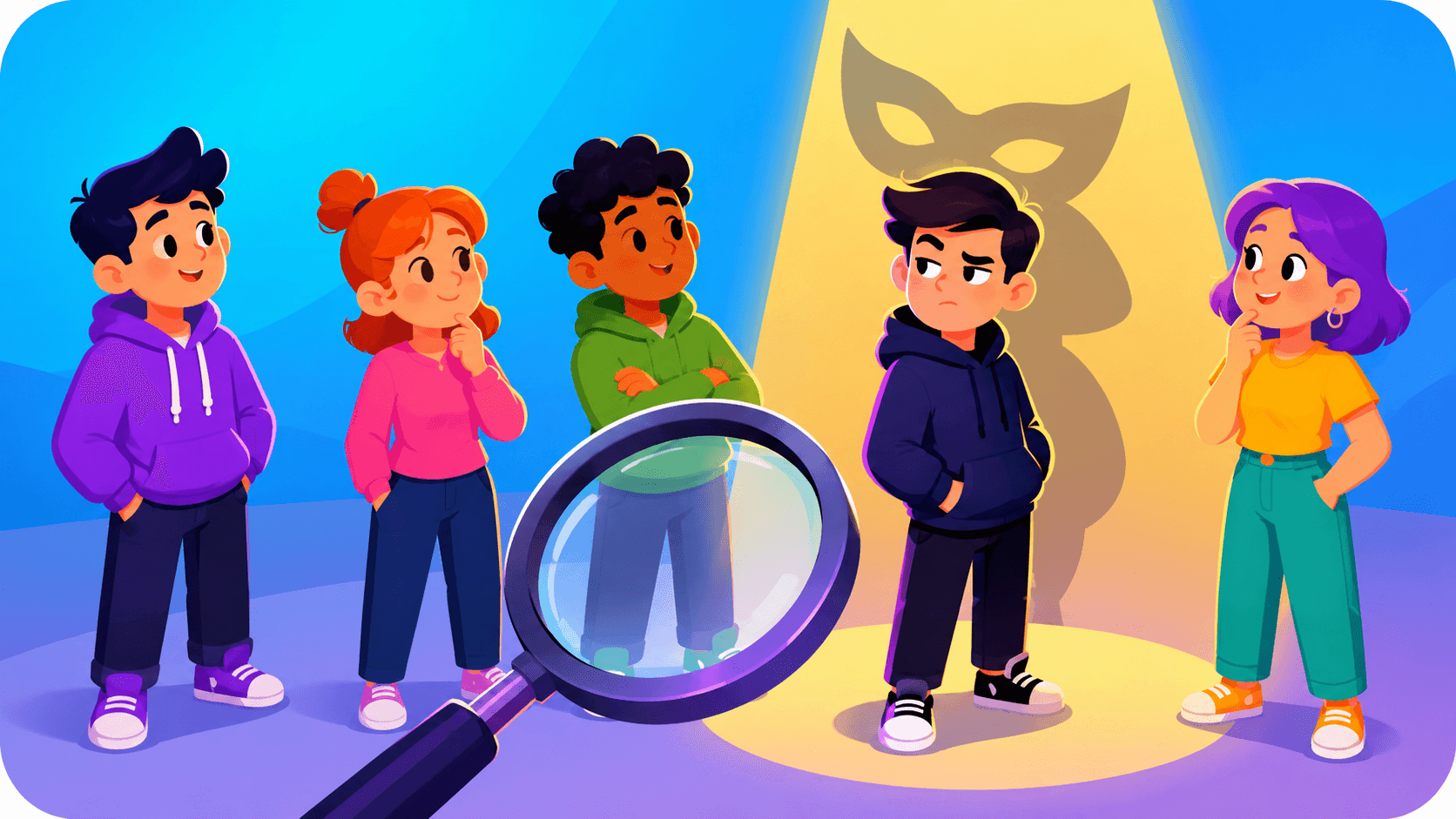
Imposter is a hidden-role game where everyone talks at the same table, but not everyone knows the same word. Most players see the real word. The impostor does not see the word; they only see that they are the impostor and, if hints are enabled, a short hint.
That is where the tension starts. Players who know the word try to test each other without saying too much. The impostor listens to answers, small details, and table reactions to infer the word and blend in.
When you play Imposter online, roles are assigned secretly, the word and hint are shown privately, and then discussion begins. At the end of the round, the group votes for as many players as there are impostors. If every impostor is found, the players who knew the word win. If any impostor slips through, the impostor side wins.
How to Play Imposter
- Each player secretly receives a role.
- Most players see the same hidden word.
- Impostor players do not see the word; if the setting is enabled, they only see a short hint.
- Players speak in turn and try to show they know the word.
- After discussion, the group votes for the players they think are impostors.
The most important part of the round is the conversation. Players who know the word need to prove it, but if they are too direct, the impostor can solve it. The impostor looks suspicious if they stay silent, but one wrong detail can expose them.
A good round makes everyone take a small risk. One answer can sound innocent but feel too generic. Another answer can reassure the players who know the word while giving the impostor too much information.
Word and Hint Balance
A good Imposter card depends on how close the word and hint are. The word is the real answer shown to players who know it. The hint is the short clue shown to the impostor.
If the hint is too close, the impostor solves the word immediately. If it is too far away, they cannot join the conversation and will stand out in the first turn. A good hint suggests the category or atmosphere without saying the word.
For an animal word, the hint might point to a habitat, an associated object, or a general behavior. For a movie, game, sport, or food term, the hint gives the impostor something to talk about without naming the answer. The goal is to help the impostor join the conversation, not hand over the solution.
Playing as a Normal Player
Players who know the word are not only trying to find the impostor. They also need to protect the word. Direct clues make it easier for the impostor to hide.
Good answers mean something to the players who know the word but do not give the answer away to the player who does not. Questions like "Where would you see this?", "What is the mood of this?", or "What feeling comes to mind first?" can reveal knowledge without naming the answer.
Listening matters as much as speaking. Players who give overly broad answers, repeat someone else's wording, or stay safe but empty on every turn are worth testing.
Surviving as the Impostor
Because the impostor does not know the word, their first job is to read the table. Which ideas keep coming back? Which associations make people laugh? Which answers are accepted too easily? All of that can become a clue.
Staying completely silent is usually a bad move. A few careful questions show that you are part of the conversation. But if your questions are too broad, other players may realize you do not know the word.
If hints are enabled, use the hint without overtrusting it. The hint gives context, not a guaranteed answer. Once the impostor has a theory, they can answer as if that theory is true, but they should stay flexible enough to adjust when new information appears.
Voting and the Reveal
When discussion ends, the group votes for who they think the impostor is. The number of selected players follows the number of impostors, so a round with multiple impostors requires the group to identify more than one player.
Normal players win only if all impostors are chosen. If even one impostor avoids the vote, the impostor side wins. That means the table needs to consider every inconsistency, not just the loudest suspect.
The best reveal happens when the word and roles are shown after voting. A player may have blended in without ever knowing the word, or someone who knew the word may have sounded suspicious because they were being too careful. Those moments are what make the group want another round.
Word Packs
Imposter feels different depending on the word pack. Daily Life gives broad, easy-to-understand rounds. Party, Movies, Football, Travel, Video Games, Sports, Celebrities, Fictional Characters, Animals, and Food create more focused conversations around shared interests.
The pack changes the difficulty. With common daily words, the impostor has more room to infer the answer. With more specific packs, players who know the word can use sharper associations, but the hint still needs to give the impostor a way into the conversation.
What Makes a Good Round?
In a good round, players who know the word never fully relax. Every answer gives a little information but does not reveal the word outright. The impostor should not look completely lost; they should be able to use the table to stay believable.
If discussion lasts too long, the game can drift. If it is too short, suspicion does not have time to build. The best rhythm gives everyone at least one chance to speak, tests a few players, and reaches the vote with real uncertainty still in the room.
The conversation after the reveal is often part of the fun: "How did you answer that?", "I thought you were the impostor right there," or "You got that from the hint?" keeps the round alive after the result.
Frequently Asked Questions
Can you play Imposter online?
Yes. In online play, roles are assigned secretly, most players see the word, and the impostor sees their role without the word plus a hint if hints are enabled. Discussion and voting happen in the same game.
What does the impostor see?
The impostor does not see the real word. They only see that they are the impostor and, if hints are on, a short hint.
Should hints be enabled?
Hints are enabled by default because they make the first rounds easier to join. Turning hints off makes the impostor role harder and gives the group a tougher guessing game.
Can players say the word directly?
No. Saying the word directly breaks the tension. Players should prove they know it without giving the answer to the impostor.
How many players do you vote for?
The group votes for as many players as there are impostors. If every impostor is selected, the players who knew the word win. If the vote misses any impostor, the impostor side wins.